From Oshirabe to Banshiki Jo no mai, by way of Gaku. A journey through Noh country

Shôka of Oshirabe without the fingerings – Shouka of Oshirabe without fingering In two years, here are the pieces I have learned, in the order I learned…

Translated from the French by Claude. Read the original. · 日本語

Shôka of Oshirabe without the fingerings – Shouka of Oshirabe without fingering

In two years, here are the pieces I have learned, in the order I learned them. In a book from the Isso school, I counted 43 flute pieces, Oshirabe included. I think the order of learning is often similar. One starts with the « easiest » and goes on to the « hardest », leaving aside the pieces that are too specific.

A peculiarity of my teacher: he had me begin with Otoko-mai, which is faster than Chû-no-mai, itself faster than Jo-no-mai. I know, by hearsay, that in the Isso school they begin rather with Jo-no-mai and work on Otoko-mai only much later.

– Oshirabe お調べ: the opening piece. It is played every time one picks up the flute, at the start of each lesson and at every performance. The musicians settle in the mirror room and « tune themselves » to the mask the shite will wear during the play, by playing Oshirabe facing the mask before going on stage and taking their places.

– Otoko mai 男舞: literally, the dance of the men. Often played for plays about warriors.

– Ôshiki Haya mai 黄鐘 早舞: Otokomai with a different Nidan and Tome. Example: Atsumori.

– Chû no mai 中之舞: dance at a medium tempo. Often used for nô plays about women. Example: Yuya.

– Chû no mai with Taiko 中之舞•太鼓 (only kakari and tome change).

– Haya mai 早舞: literally « fast dance », a sort of Otokomai in Banshiki mode (high).

– Haya mai of Tôrû, Hayamai of Iroe イロエ•早舞 (here it is the Jo, the introduction before Kakari, that changes).

– Kami mai 神舞: dance of the gods.

– Kakko 羯鼓: a Chinese dance, or a dance for characters who must show off their skill. Example: Kagetsu.

– Sagariha 下リ端: for monster characters, for « angel women ». Example: Kuzu.

– Gaku 楽: for Chinese characters or Japanese kami. This dance is said to come from Gagaku.

– Banshiki Gaku 盤渉 楽: Gaku in the high mode.

– Hayafue 早笛: entrance music for demons and madmen. Examples: Tengu, Obeshi

– Jo no mai 序之舞: a sort of very slow Chu-no-mai. A very elegant dance of women, tree spirits or old men.

– Kagura 神楽: a very elegant dance. Often goddesses or priests carrying treasures.

– Mominodan: part of Sambasô 三番叟 in Okina . A song of thanksgiving in which the kyôgen actor lets out long cries in answer to the percussion.

– Suzunodan: part of Sambasô 三番叟 in Okina, where the kyôgen actor enters with a bell symbolising the prosperity of the harvest.

– Banshiki Jo no mai 盤渉 序之舞: Jonomai but in the high mode.

お調べから盤渉序之舞まで、楽を経て。能の国の旅路

指使いを省いたお調べの唱歌 Shouka of Oshirabe without fingering…

この記事はクロード(Claude)がフランス語から翻訳したものです。原文(フランス語)を読む。 · English

 指使いを省いたお調べの唱歌 Shouka of Oshirabe without fingering

この二年間で習った曲を、習った順に並べてみる。一噌流の本では、お調べを含めて笛の曲が43曲数えられた。習う順序はたいてい似たようなものだと思う。「易しい」ものから「難しい」ものへ進む。あまりに特殊な曲は別にしておく。

私の師匠は少し変わっていて、まず男舞から始めさせた。男舞は中之舞より速く、その中之舞は序之舞より速い。聞くところでは、一噌流ではむしろ序之舞から始め、男舞に取りかかるのはずっと後になってからだという。

– お調べ(Oshirabe):開幕の曲。笛を手にするたびに吹く。稽古の初めにも、公演のたびにも吹く。公演では、囃子方が鏡の間に入り、シテが掛ける面に向かってお調べを吹き、面と「調子を合わせる」。それから舞台に出て座に着く。

– 男舞(Otoko mai):文字どおり「男の舞」。武将の出る曲によく用いられる。

– 黄鐘早舞(Ôshiki Haya mai):二段と留が変わる男舞。例:『敦盛』。

– 中之舞(Chû no mai):中くらいの速さの舞。女を主役とする能によく使われる。例:『熊野』。

– 中之舞・太鼓(Chû no mai、太鼓入り):変わるのはカカリと留だけ。

– 早舞(Haya mai):文字どおり「速い舞」。盤渉(高い調子)で吹く、男舞のようなもの。

– 『融』の早舞(Tôrû)、イロエ早舞(Iroe):この場合は序、すなわちカカリの前の導入部が変わる。

– 神舞(Kami mai):神々の舞。

– 羯鼓(Kakko):中国風の舞、あるいは技の巧みさを見せるべき人物のための舞。例:『花月』。

– 下リ端(Sagariha):怪物や「天女」の役のための曲。例:『国栖』。

– 楽(Gaku):中国の人物や日本の神のための曲。この舞は雅楽に由来するといわれる。

– 盤渉楽(Banshiki Gaku):高い調子の楽。

– 早笛(Hayafue):鬼や狂人の登場の音楽。例:天狗、オベシ。

– 序之舞(Jo no mai):非常にゆっくりした中之舞のようなもの。女、木の精、あるいは老人の、たいへん優雅な舞。

– 神楽(Kagura):たいへん優雅な舞。女神や、宝を持った神職が舞うことが多い。

– 揉ノ段(Mominodan):『翁』の三番叟の一部。感謝の歌で、狂言方が打楽器に応えて長い掛け声を上げる。

– 鈴ノ段(Suzunodan):『翁』の三番叟の一部。狂言方が、五穀豊穣を表す鈴を持って登場する。

– 盤渉序之舞(Banshiki Jo no mai):序之舞を高い調子で吹くもの。

De Oshirabe à Banshiki Jo no mai, en passant par Gaku. Périple en terre de Nô

 Shôka de Oshirabe sans les doigtés – Shouka of Oshirabe without fingering

En deux ans, voilà les pièces que j’ai apprises, dans l’ordre de leur apprentissage. Dans un ouvrage de l’école Isso, j’ai dénombré 43 morceaux de flûtes en comprenant Oshirabe. Je pense que l’ordre d’apprentissage est souvent semblable. On commence du plus « facile » au plus « difficile ». En gardant de côté les morceaux trop spécifiques.

Particularité de mon maître, il m’a fait commencé par Otoko-mai qui est plus rapide que Chû-no-mai, lui même plus rapide que Jo-no-mai. Je sais, par ouïe dire que, dans l’école Isso, ils commencent plutôt par Jo-no-mai et ne travaillent Otoko-mai que beaucoup plus tard.

– Oshirabe お調べ : pièce d’ouverture. On la joue à chaque fois qu’on prend la flûte, au début de chaque cours et à chaque spectacle. Ils s’installent alors dans la chambre aux miroirs et « s’accordent »  au masque que portera le shite pendant la pièce en jouant Oshirabe face au masque avant d’entrer en scène et de s’installer.

– Otoko mai 男舞 : Littéralement, la danse des hommes. Souvent joué pour les pièces de guerriers.

– Ôshiki Haya mai 黄鐘 早舞 : Otokomai avec Nidan et Tome qui changent – Exemple : Atsumori.

– Chû no mai 中之舞 : danse au tempo moyen. Souvent utlisé pour les nô de femmes. Exemple : Yuya.

– Chû no mai avec Taiko 中之舞•太鼓(change seulement kakari et tome).

– Haya mai 早舞 : littéralement « danse rapide » sorte d’Otokomai en mode Banshiki (aigu).

– Haya mai de Tôrû, Hayamai de Iroe イロエ•早舞 (Ce sont alors les Jo (introduction avant Kakari) qui changent).

– Kami mai 神舞 : Danse des dieux.

– Kakko 羯鼓 : danse chinoise ou dans pour des personnages qui doivent démontrer leur habilité- exemple : Kagetsu.

– Sagariha 下リ端 : pour personnages de monstres, de « femme ange » – exemple : Kuzu.

– Gaku 楽 : pour personnages chinois ou kami japonais. On dit que cette danse viendrait du Gagaku.

– Banshiki Gaku 盤渉 楽 : Gaku en mode aigu.

– Hayafue 早笛 : Musique d’entrée pour les démons, les fous – exemple : Tengu, Obeshi

– Jo no mai 序之舞 : sorte de Chu-no-mai très lent. Danse de femme, d’esprits des arbres ou de vieil-hommes très élégante.

– Kagura 神楽 : danse très élégante. Souvent des déesses ou des prêtres portant des trésors.

– Mominodan : partie de Sambasô 三番叟 dans Okina – chant de remerciements où le kyôgen pousse de longs cris en réponse aux percussions.

– Suzunodan : partie de Sambasô 三番叟dans Okina où le kyôgen entre avec une cloche symbolisant la prospérité des récoltes.

– Banshiki Jo no mai 盤渉 序之舞 : Jonomai mais dans le mode aigu.

The English say Nohkan, the French Nokan, and the Japanese call it: Fue Kata or Fue

Nôkan fingerings – Fingering Nohkan – Morita Ryu – Sensei Saco Yasuhiro It is rather strange that, despite two years of regular lessons (I go to Japan…

Translated from the French by Claude. Read the original. · 日本語

Nôkan fingerings – Fingering Nohkan – Morita Ryu – Sensei Saco Yasuhiro

It is rather strange that, despite two years of regular lessons (I go to Japan once a week, for two years now, for a one-hour weekly lesson!) and untimely research, I have almost never talked about the Nôkan here.

Yet when you try to look into the subject, it is almost impossible to find any reference at all, and when they exist they are often approximate and/or incomplete. There are, I am sure, mines of information on the net for those who read and write Japanese. Unfortunately, I am not one of them.

Of course, this is an instrument practised in the intimacy of temples or traditional rooms of a few tatami with paper doors. Here, we enter the codes of ancient Japan. The master (sensei, the one who masters and transmits his art) receives you in a kimono. Sitting in seiza, behind a little wooden cube on which he beats the measure while singing the lines of the percussion, he faces the students, who go through one after the other in respectful silence. Those who wait for their turn drink tea around a low table and murmur their shoka between their teeth, while supporting the student who, facing the master, goes through the ordeal of rhythms broken by shouts. Like a fight lost in advance. With a knot in the throat, one awaits one’s turn. And once one has been through it, one stays another half hour or an hour to recover from this face to face.

Here, there is no schedule. The class runs from 6 to 9 pm and you just come. You take your place beside the other students and wait patiently for your turn. Often, afterwards, as a reward, we meet in a little Japanese restaurant. The sensei has taken off his master’s garb, set down his mask and the codes of this ancestral art, to put on the costume of the simple 21st-century man he is in town. A man who drinks, laughs and chats with his students, who have become, once past the pediment of the temple, something like his friends.

The Nô flute, the Nôkan, is the instrument by which the spirits are called to descend onto the butai (the stage of the nô theatre) to take possession of the dancer-actors. One will then understand the full importance of the ceremonial. We are no longer simply music students, we are learning to rub shoulders with the gods, with their rules and their moods. It is forbidden, for example, to wear a necklace or a watch, any jewellery that could hinder the coming of the music. The flute is not held like a « vulgar » instrument. The way of taking it in hand is governed by multiple codes that are repeated tirelessly.

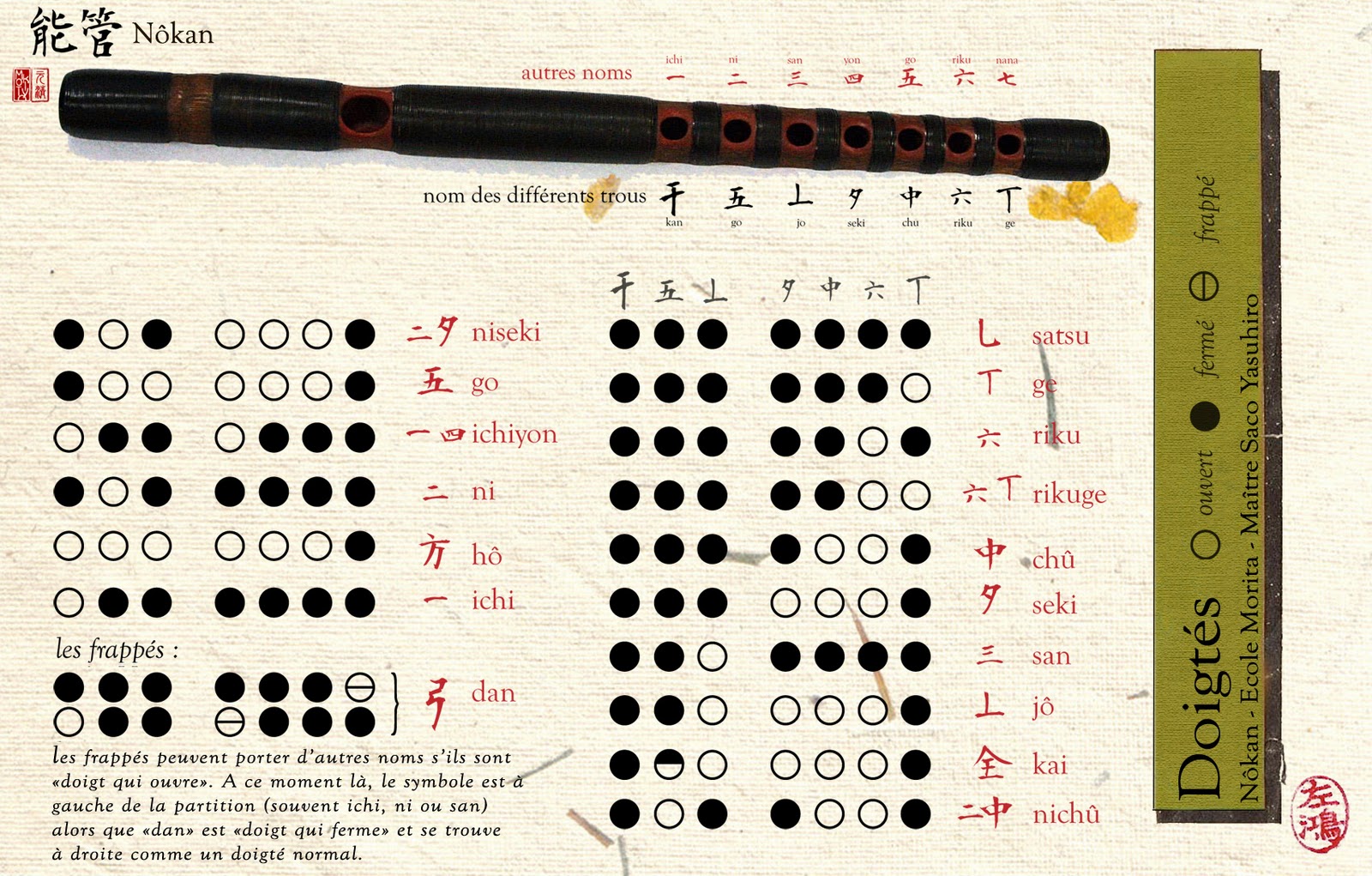
In this art, there are no books, no scores. The master, when he judges that we have mastered a piece well enough, writes out the next shoka for us on Japanese music paper, divided into eight beats from top to bottom, on eight lines from right to left. The shoka is the song. The syllables in katakana do not represent the notes, only the song. A ヒャ (Hya) may be, in one phrase or piece, a seki (the name of one of the fingerings, see the chart) and, in another phrase or piece, a Jô (another fingering).

The master then, beside his shoka written in black ink, inscribes in red ink the secret keys that will allow the Nôkan to take back its rights and intone the secret music hidden behind these katakana.

But beware, the shoka still gives the rhythmic information! And besides, by singing them in our heads while we play, the nôkan sounds in a different way! That, at least, is what we are told!

For all these reasons, one will readily understand that its diffusion remains minimal. At the same time, it is also thanks to this that the Nôkan, like the other instruments of the nô theatre, keeps this inimitable character. Here, the West has not entered! It is behind the door… it dreams, it fantasises. Like about the samurai and the shogun whom, for an instant, thanks to this music, we find again. Out of space and time. Elsewhere.

Editor’s note: I AM SPEAKING HERE OF A SINGULAR EXPERIENCE TIED TO ONE MASTER AND ONE SCHOOL: MORITA SCHOOL. The other two schools, the best known ISSO and the third, FUJITA, may not transmit in the same way. What I do know, for example, is that the ISSO school has many different fingerings.

英語では「Nohkan」、フランス語では「Nokan」、日本語では「笛方」あるいは「笛」

能管の指使い – Fingering Nohkan – 森田流 – 左鴻泰弘先生 二年間、定期的に稽古に通い(この二年、週に一度、一時間の稽古のために日本へ通っているのだ)、あれこれと調べてもきたのに、ここで 能管…

この記事はクロード(Claude)がフランス語から翻訳したものです。原文(フランス語)を読む。 · English

能管の指使い – Fingering Nohkan – 森田流 – 左鴻泰弘先生

二年間、定期的に稽古に通い(この二年、週に一度、一時間の稽古のために日本へ通っているのだ)、あれこれと調べてもきたのに、ここで能管のことをほとんど書いてこなかったのは、我ながら不思議なことだ。

ところが、この楽器について調べようとしても、資料と呼べるものはほとんど見つからず、あっても大概は不正確か不完全である。日本語を読み書きできる人のためには、ネット上に情報の宝庫がきっとあるはずだ。残念ながら、私はその一人ではない。

もちろん、これは寺の奥や、障子で仕切られた畳数枚の伝統的な部屋で、ひっそりと稽古される楽器である。ここでは、古き日本の作法に入ることになる。先生(sensei、芸を会得し、それを伝える人)は着物姿で私たちを迎える。正座し、小さな木の箱を前にして、囃子の旋律を唱えながらその箱で拍を打ち、順番に出てくる生徒たちと向かい合う。静かな敬意の中で。順番を待つ者たちは、低い卓を囲んでお茶を飲み、口の中で唱歌をつぶやきながら、先生の前で、掛け声に断ち切られるリズムの試練を受けている生徒を支える。はじめから負けの決まっている戦いのようだ。喉を締めつけられる思いで、自分の番を待つ。そして自分の番が終わっても、この対峙から立ち直るのに、さらに三十分か一時間はそこに留まる。

ここには時間割というものがない。稽古は18時から21時までで、人は来る。ほかの生徒の隣に座り、辛抱強く自分の番を待つ。稽古のあと、褒美のように、小さな日本料理店で皆と落ち合うことも多い。先生は師匠の装いを脱ぎ、面を置き、この古来の芸の作法を置いて、町では二十一世紀のごく普通の男に戻っている。酒を飲み、笑い、生徒たちと語らう男。寺の門をくぐってしまえば、生徒たちはいわば友人になるのだ。

能の笛、能管は、霊を呼び、舞台(能舞台の板の間)に降り立たせて、舞い手であり役者である者に取り憑かせるための楽器である。そう考えれば、儀礼のすべてがいかに大切か分かるだろう。私たちはもはや単なる音楽の生徒ではなく、神々のそばで生きることを学んでいる。神々には神々の決まりがあり、気分がある。たとえば、首飾りや腕時計など、音楽の訪れを妨げかねない装身具は一切禁じられている。笛は「ありふれた」楽器のようには持たない。その持ち方は数多くの作法に定められていて、それをひたすら繰り返し稽古する。

この芸には、書物も楽譜もない。先生は、ある曲を十分に会得したと判断すると、次の唱歌を日本の譜面用紙に書いてくれる。紙は上から下へ八拍に分けられ、右から左へ八行が並ぶ。唱歌とは歌である。カタカナの音節は音の高さを表すのではなく、歌だけを表す。たとえば「ヒャ」(Hya)は、ある句やある曲ではセキ(指使いの名の一つ。表を参照)であり、別の句や別の曲ではジョウ(別の指使い)であったりする。

すると先生は、黒インクで書いた唱歌の傍らに、赤インクで秘伝の鍵を書き込む。それによって能管が本来の力を取り戻し、これらのカタカナの陰に隠された秘密の音楽を奏でることができるようになる。

だが注意してほしい、唱歌はそれでもリズムの情報を与えてくれるのだ。それに、吹きながら頭の中で唱歌を歌うと、能管は違った響きで鳴る。少なくとも、私たちはそう教わる。

こうしたことすべてから、この芸があまり広まらないのも容易に理解できるだろう。同時に、そのおかげでもあるのだ、能管が、そして能のほかの楽器が、まねのできない独特の性格を保っているのは。ここに西洋は入っていない。扉の向こうにいて、夢を見、思いを巡らせている。サムライや将軍について夢想するように。この音楽のおかげで、私たちは一瞬そこに立ち戻る。空間と時間の外に。どこか別の場所に。

編集者注:ここで述べているのは、一人の師匠と一つの流派に結びついた個人的な経験である。森田流のことだ。ほかの二流派、最もよく知られた一噌流と、三番目の藤田流は、同じやり方で伝えてはいないかもしれない。たとえば、一噌流には指使いの種類がずっと多いということは私も知っている。

Les anglais disent Nohkan, les français Nokan et les Japonais l’appellent : Fue Kata ou Fue

Doigtés de Nôkan – Fingering Nohkan – Morita Ryu – Sensei Saco Yasuhiro

Il est assez étrange que malgré deux années de cours réguliers (Je vais au Japon une fois par semaine depuis deux ans pour une heure de cours hebdomadaire !) et de recherches intempestives, je n’ai presque jamais parlé de la Nôkan ici.

Pourtant quand on essaye de se pencher sur le sujet, il est quasiment impossible de trouver quelque référence que ce soit et quand elles existent, elles sont souvent approximatives et/ou incomplètes. Il existe, je suis sûr, pour ceux qui lisent et écrivent le japonais, des mines d’informations sur le net. Malheureusement, je ne suis pas de ceux-là.

Bien sûr, il s’agit là d’un instrument qu’on pratique dans l’intimité des temples ou de pièces traditionnelles de quelques tatamis aux portes de papier. Ici, nous entrons dans les codes de l’ancien Japon. Le maître (sensei, celui qui maîtrise et transmet son art) vous reçoit en kimono. Assis en seiza, derrière un petit cube en bois sur lequel il tape la mesure en chantant les lignes des percussions, il fait face aux élèves qui passent l’un après l’autre, dans un silence respectueux. Ceux qui attendent leur tour boivent le thé autour d’une table basse et murmurent entre leurs dents leur shoka, tout en soutenant l’élève qui, face au maître, passe à l’épreuve des rythmes coupés de cris. Comme un combat perdu d’avance. La gorge nouée, on attend son tour. Et quand on sera passé, on restera encore une demie-heure ou une heure pour se remettre de ce face à face.

Ici, il n’y a pas d’horaire. Le cours est de 18h à 21h et on vient. On prend place à côté des autres élèves et on attend patiemment son tour. Souvent, après, comme une récompense, on se retrouve dans un petit restaurant japonais. Le sensei a quitté son habit de maître, déposé son masque et les codes de cet art ancestral pour revêtir le costume de l’homme simple du 21ème siècle qu’il est à la ville. Un homme qui boit, qui rigole et devise avec ses élèves, devenus, une fois le fronton du temple franchi, comme ses amis.

La flûte de Nô, la Nôkan, est l’instrument par lequel on appelle les esprits à descendre sur le butai -plateau du théâtre nô– pour venir prendre possession des danseurs-acteurs. On comprendra, alors, toute l’importance du cérémonial. Nous ne sommes plus simplement des élèves en musique, nous apprenons à côtoyer les dieux, avec leurs règles, leurs humeurs. Il est, par exemple, interdit de porter un collier ou une montre, un quelconque bijou qui pourrait entraver la venue de la musique. La flûte ne se tient pas comme un « vulgaire » instrument. Sa prise en main est régie de multiples codes qu’on répète inlassablement.

Dans cet art, il n’y a pas de livres, de partitions. Le maître, quand il estime que nous maîtrisons un morceau suffisamment, nous écrit le prochain shoka sur du papier à musique japonais, divisé en huit temps de haut en bas, sur huit lignes de droite à gauche. Le shoka est le chant. Les syllabes en katakana ne représentent pas les notes, seulement le chant. Un ヒャ (Hya) pourra être dans une phrase ou une pièce un seki  (nom d’un des doigtés – CF tableau) et dans l’autre phrase ou pièce un  Jô (autre doigté).

Le maître, alors, à côté de son shoka écrit à l’encre noire, inscrit, d’une encre rouge, les clés secrètes qui permettront à la Nôkan de reprendre ses droits et d’entonner la musique secrète cachée derrière ces katakana.

Mais attention, le shoka donne tout de même les informations rythmiques ! Et puis, en les chantant dans notre tête en même temps que l’on joue, la nôkan sonne d’une autre manière ! C’est en tout cas, ce qu’il nous est dit !

Pour tout cela, on comprendra aisément que sa diffusion reste minime. En même temps, c’est aussi grâce à cela que la Nôkan, ainsi que les autres instruments du théâtre nô, gardent ce caractère inimitable. Ici, l’occident n’est pas entré ! Il est derrière la porte… il rêve, il fantasme. Comme sur les samurai et les shogun qu’un instant, grâce à cette musique, nous retrouvons. Hors de l’espace et du temps. Ailleurs.

NDLR : JE PARLE ICI D’UNE EXPÉRIENCE SINGULIÈRE LIÉE À UN MAÎTRE ET UNE ÉCOLE : ECOLE MORITA. Les deux autres écoles, la plus connue ISSO et la troisième FUJITA ne transmettent peut-être pas de la même façon. Ce que je sais, par exemple, c’est que l’école ISSO a beaucoup de doigtés différents.

Noh, Baroque Music and on the road… Suma Bay

Eternal Great Dragon of the Higashi – Hongangi Temple Not much battery left… We have just changed trains at Tokyo, it is 9:30 and we are on our way to…

Translated from the French by Claude. Read the original. · 日本語

Eternal Great Dragon of the Higashi – Hongangi Temple

Not much battery left…

We have just changed trains at Tokyo, it is 9:30 and we are on our way to Niigata. Only a few hours from Sado Island and the statue of Zeami, which will show me for the first time the face of this man beside whom I have spent so many years.

The train for Niigata departing from Tokyo station… Rose would have loved this.

18%… I do not know whether it will be enough to tell you about this Thursday 30 July, an astonishing Thursday.

What we know, on getting up, is that this afternoon we have a rendezvous with Saco Sensei in Osaka to accompany him to his concert, where he will be surrounded by four classical musicians, fans of baroque music. It is an event I have been looking forward to impatiently since the first flute lesson where I was invited. The meeting is set for 3:30 pm at Osaka station. Which leaves us a morning and an early afternoon free. Good, we do not know Osaka and it is by the sea, we will take the chance to go for a swim. We set the alarm and take off quite early. By bicycle or by metro? The train for Osaka is taken at Kyoto Station, which is to the south, twenty-five minutes by bicycle… « Ok! Bicycle it is! » That way I will introduce her, in passing, to his lordship the Great Dragon of the Higashi – Hongangi Temple, which lies a few hundred metres north of Kyoto Station, so on the way.

The Great Dragon of the Higashi – Hongangi Temple welcomes Elise


The ride is quickly done. We deserve no credit, it is just that in this direction it is one long gentle slope. Here we are at the Higashi – Hongangi. I take Elise to the north gate, the one by which I entered the first time. I am surprised by the crowd this morning. Nothing like the sort of waking dream I lived with the Great Dragon and Hideo, where we were only three sharing the courtyard of this monumental temple. And for good reason! The enormous scaffolding that covered the whole temple has since been half taken down and gives access to the Hongangi. In ten days they have finished this work site that nonetheless seemed far from done.

The imposing Hongangi Temple


Once past this first surprise, I introduce her to the Great Dragon and feel exactly the same inner draught as the first time. I think Elise pleases him. He lets her wash her hands in the pure water from his mouth. As for me, I am eyeing the steps of the temple…. « Shall we take five minutes? » « Yes, let’s take them! » Time to take off the shoes (and for me the socks… after tasting the happiness of bare feet on these old wooden floors, it is hard to resist), and there we are, wandering through this imposing temple. As Elise rightly says, the wood, here very dark, seems harder, colder than what one usually meets in temples. As if this one were of oaks when the others are of pines. Sutras are hung all along the corridors leading to the temple (and which we take backwards, of course) and offer us their joyful maxims:

« It isn’t external things that restrict us ; it’s our minds attached to the things that restrict us. » Ryôshun Nakano

Lamps with maxims in Japanese… opening the way to the Amida Hall

Then we cross paths with a group that seems to be going to a ceremony, accompanied by priests. We follow them from afar, or rather our stroll, taking us from lantern to lantern in this temple, pushes us as far as the Amida Hall, where we find the said group again. We settle behind them in seiza and follow the prayers for a long while in this padded, cool hall where the voices of the priests blend into one another.

The Amida Hall of the Higashi – Hongangi Temple…


Time is ticking. When we come out, it is 11:30. We dash to Kyoto Station and get ready to take the train to Osaka. An idea crosses my mind… Osaka is a city, a big city even. We will never find a beach at the exit of the train… So! « We want go to the beach, but we need… » anyway, I explain everything to the platform attendant, who proves very patient and understanding. Our appointments, our wish for the sea and so on and so forth. She writes down lots of things for us on a little piece of paper, with a station name and a few changes. We are supposed to take an hour and a quarter to get there and half an hour from there to return to Osaka. Enough to go « splash » in the water and « hop » onto the train. At the same time, the train is a good way to see the landscape and the atmospheres of the places passed along the way. And would you believe the first change is at Kobe! Kobe is, I know, not far from the tomb of Atsumori! At the moment of changing, I take five minutes to dash off and see whether there is a statue in the station or an information centre, but nothing. Never mind! Anyway, today we said beach, we are going to the beach. We climb into the second train and, just as we sit down, a voice is heard: « Are you French? » « Er… yes! I believe so… » He too is a Gaul, expatriated in Australia for ten years and living in Japan for two. He advises us against the beach indicated by the girl at the station and suggests we go two stations further. Besides enjoying an environment more conducive to relaxation (the beach we were to go to is covered in bars and arcades with one young surfer per square centimetre), we will be able to discover the largest suspension bridge in the world, the « Akashi Kaikyo », no less. Do not ask me the name of the island it allows you to reach, but what I can tell you is that it is enormous and some three kilometres eight hundred long. The Frenchman gets off the train two stations before us… « Suma station. » « Suma?! Did you say Suma!!!! » By the time I make the connection it is already too late, but in my head the words line up: « By the sea of Suma, narrow, alas, is the path that leads to my house and back. » ATSUMORI!!!! It is here! It is here that he fought his last combat with Kumagai. Yes! Yes! Between the arcades and the snack bar… right there! The train sets off again. No matter, our dip in the water will only be a little shorter: on the way back, we will stop at Suma station.

the Akashi Kaikyo, largest suspension bridge in the world! It links the bay beyond that of Suma to…

We get off the train and go as fast as our legs will carry us toward the beach… « To the left of the bridge… » Oh yes, right! To the left of the bridge, three kilometres away!!! And we have, at the very most, a quarter of an hour. We take the chance to abandon our chase and sit in the shade of this enormous suspension bridge, next to a band of old men playing a Japanese game of checkers or chess. It is good to see them, settled in the shade of this giant bridge and bursting into great peals of laughter followed by shrill exclamations. Another watches the game from afar, but prefers the spectacle of the boats going by (when one does go by), which he follows with a pair of enormous binoculars. We settle in with them and eat the rice cakes with seaweed that we had bought for lunch, then we bid them goodbye and head back to the station, the noise of cars crossing the bridge still in our ears.

« a band of old men playing a Japanese game of checkers or chess… »

At Suma, I rush off to find an information centre. But Atsumori means nothing to them. They can point me to the best surf spot, but « Ichi No Tani in Suma Bay »… no! Time is flying and we have ten minutes to find out whether or not this is indeed the Suma of Atsumori. She finally pulls out a map and there, at the bottom left, I see it: « Ichi No Tani »! I show her and at the same instant she turns to me with a victorious face: « Atsumori des » (It is Atsumori), and indeed, there, under her finger, it is written: Atsumori… Victory! But it is two kilometres from the station and one does not keep a Japanese master waiting. I take the map, circle the spot and turn toward the circled place on the map to tell it that we will be back soon. We jump onto the train that takes us back to Kobe, then Osaka. It is 3:20 pm, we have ten minutes to find the meeting point. I thank Elise who, since she has been here, has twice taken me, by chance, along the paths of my quest. I am dazed; chance, in Japan, does not exist.

In the shade of the Akashi Kaikyo

Saco Sensei awaits us under the giant clock at the north exit of Osaka station. He is, as always, in traditional dress. It is funny to see him like that amid all these « Westernised » people. He suggests we take a taxi and a few minutes later we are in a very small exhibition room, on the first floor of a very small shop. The other musicians are already there. There is a harpsichord and an impressive number of flutes. What is all the more impressive is that no two flutes are alike! Most are creations, those of a man who supports their research work and draws inspiration from old medieval illustrations: flutes in cow horns or ibex horns, transverse flutes, recorders, flutes of all shapes and sizes. And of course, our Master Saco and his « Fue ». The leader of the group, who composes some of the pieces they play (the others are European classics), is one of Master Saco’s students.

« Most are creations, those of a man who supports their research work and draws inspiration from old medieval illustrations… »

We settle in nice and quietly and watch them prepare. One of the two flautists hangs Noh masks on the wall, while the leader and the harpsichordist rehearse difficult passages. Master Saco waits patiently to one side. He comes over from time to time to ask us a question or explain the programme. What kind of questions? The kind where… he arrives with a sheet of paper on which is written « François Couperin », then another with « Claude Lelouch » and « Villeret », and each time asks us for the pronunciation. He studied French at university and is passionate about French cinema. « Oh really! Does French cinema still exist? » (that is me asking him.. 😉 )

Then it is his turn to play. He sits in seiza on a sort of shabby old bench and begins to play. I recognise passages of « Otoko Mai », the piece I am learning… the classic of the danced passages of Noh. For the rest, the mixture of flutes, harpsichord and the « Contemporary Music » type of composition does not win me over. There are interesting passages, but in general the inevitable dissonance (each Noh flute is unique and is tuned to no other, only the intervals between notes are respected) is pushed, to my mind, to where it is least effective. It is as if he had tried to recreate a Noh ensemble with two Western-type flutes for the Kotsuzumi and the Otsuzumi and with the harpsichord for the Taiko part (the big drum placed on the floor in certain nô). Here I am a tad disappointed… but Master Saco stays in place, only the two other flautists leave the stage. What happens next is incredible! Exactly what I would like to manage to draw out of Noh. Master Saco begins to play, then is joined by the harpsichordist, who plays block chords, then does string-on-string work, but with the mute. One would think one was hearing a Shamisen, a sort of four-string guitar used in Kabuki and Bunraku. What the master plays has a shattering emotional power. The flute cries out its despair, it tells its story of combat and death, of betrayal and love, of pain. Then the rhythm quickens, it is unlike anything I have heard in Noh, always supported by the harpsichord. When they finish, we are (Elise, the gentleman who resurrects flutes from the past, and I) stunned.

The Harpsichord in the very small concert room. 25 prime seats! and the horrible bench where Saco Sensei will take his place shortly to play.

I get up, I go toward the scores. I absolutely must know what the girl was playing that worked so well with the Master’s flute. It is in fact the same scale as the one used to write the chant of the Monk Rensei in Atsumori. Then I ask Saco Sensei whether what he was playing was a creation. But no, it is the dance of Okina, one of the oldest nô still performed. He also tells me it is a Kyôgen dance. I had never heard one. I did not even know there could be Kyôgen music! But he tells me it exists for certain masked kyôgen. Moreover, tonight he will play another kyôgen dance in the programme.

It is 5:30 pm. We go for a walk with Elise before the concert, which begins at 7. Osaka seems fairly modern. What I know is that it is Murakami’s favourite city and that foreigners who have stayed there often like this city very much, much more than Kyoto or Tokyo, for example. But today is not the day we will have time to discover Osaka. Just time to walk around a few blocks, to eat a bite and have a drink before the concert.

It is 6:30 pm, the room is transfigured. Chairs have been set up everywhere, the spotlights, surely there for the exhibitions, turned toward the improvised stage and our team all dressed in kimonos as in Noh. They all have the traditional fan at the belt, besides. I do not know why, but it is surely a way of showing attachment to their culture, even though they have decided to take an interest in European baroque music.

We will hear the same pieces as those played at the rehearsal. Sometimes better played, sometimes a little less. But it is a rather pleasant ensemble and medieval and baroque music (which I know very badly) is quite melodious and singing, like the gentle lament of a princess weaving on her loom the helmet of her beloved.

Master Saco will play two pieces alone, one of Noh, one of Kyôgen, then his student’s creation and finally, for the finale, this marvellous encounter between « Okina », the harpsichord and the 21st century. It is even better than this afternoon! And I can see that the audience is deeply in agreement. There is, undeniably, something important being played out here, which feeds my desire to keep searching for how to weave the links between this ancestral, sacred form and our world. Because what Noh has to offer us can be found nowhere else.

It is 10 pm. We go home to bed. I have on my iPhone tonight’s cavalcade. With the desire to roll up my sleeves and dive deeper into the darkness of this world that calls me a little more every day. Sure of finding there one day, one night, a rare and unique treasure, perhaps saving, in any case necessary for me.

Good night.

Next to the Akashi Kaikyo, this surprising house. Unfortunately we will not have time to learn more…

能、バロック音楽、そして道すがら……須磨の浦

東本願寺の永遠の大龍 バッテリーがもうあまりない………

この記事はクロード(Claude)がフランス語から翻訳したものです。原文(フランス語)を読む。 · English

東本願寺の永遠の大龍

バッテリーがもうあまりない……

東京で電車を乗り換えたところだ。9時30分、新潟へ向かっている。佐渡島と、世阿弥の像まで、あと数時間。長い年月を共に過ごしてきたこの人物の顔を、私は初めてそこで目にすることになる。

東京駅を出発する新潟行きの列車……ローズならきっと気に入っただろう。

18%……この7月30日木曜日、驚きの木曜日のことを語り尽くすのに、足りるかどうか分からない。

朝起きたときに分かっていたのは、午後に大阪で左鴻先生と会って、先生のコンサートに同行するということだった。先生は、バロック音楽を愛好する四人のクラシック音楽家に囲まれて演奏する。最初の笛の稽古に招かれたときから、心待ちにしていた催しだ。待ち合わせは15時30分、大阪駅。つまり、午前中と午後の初めは空いている。好都合だ。私たちは大阪を知らないし、海沿いの町なのだから、泳ぎにも行こう。目覚ましをかけ、かなり早くに飛び出した。自転車か、地下鉄か。大阪行きの電車は、南にある京都駅から乗る。自転車で25分だ……「よし! 自転車で行こう!」。そうすれば、ついでに、東本願寺の大龍を彼女に紹介できる。京都駅の数百メートル北にあるから、道すがらだ。

東本願寺の大龍がエリーズを迎える


道のりはあっという間だった。私たちに手柄はない。ただ、こちらの向きだと、ゆるやかな長い下り坂なのだ。そして東本願寺に着いた。エリーズを北門に連れていく。私が初めて入ったときの門だ。今朝は人出が多くて驚いた。大龍とヒデオと過ごした、あの白昼夢のような時間とは大違いだ。あのときは、この巨大な寺の境内を三人だけで独り占めしていた。それもそのはず! 寺全体を覆っていた巨大な足場は、その後半分ほど撤去され、本願寺に入れるようになっていた。まだまだ終わりそうになかったその工事を、十日で終えたのだ。

堂々たる本願寺


最初の驚きが過ぎると、大龍を彼女に紹介した。初めてのときとまったく同じ、体の内を吹き抜ける風を感じる。エリーズは龍に気に入られたと思う。龍は、自分の口から出る清らかな水で彼女に手を洗わせた。私はといえば、寺の階段のほうをちらちら見ている……「五分だけ、いい?」「ええ、いいわ!」。靴を脱ぐ時間だけで(私は靴下も。古い木の床の素足の幸せを一度味わってしまうと、抗いがたい)、私たちはもうこの堂々たる寺の中をそぞろ歩いていた。エリーズが的確に言ったとおり、ここの木はとても黒ずんでいて、ふつうの寺で見かける木よりも硬く、冷たく見える。ほかの寺が松でできているとすれば、ここは樫でできているかのようだ。寺へと続く廊下の端から端まで、お経が掛けられている(私たちはもちろん逆向きに進んでいる)。お経は私たちに、楽しげな格言を差し出してくれる。

「私たちを縛るのは外の物事ではない。物事に執着する私たちの心が、私たちを縛るのだ」( »It isn’t external things that restrict us ; it’s our minds attached to the things that restrict us. »)ナカノ・リョウシュン

日本語の格言が書かれた灯り……阿弥陀堂へ続く道を開いてくれる

それから、僧侶たちを伴って、何かの法要へ向かうらしい一団とすれ違った。私たちは遠くからついていく。というより、灯籠から灯籠へと私たちを誘うこの散策が、その一団のいる阿弥陀堂まで私たちを押しやったのだ。私たちは彼らの後ろに正座して、閉ざされたひんやりとした堂の中で、僧侶たちの声が互いに混じり合うのを聞きながら、長いこと読経に付き合った。

東本願寺の阿弥陀堂……


時間が過ぎていく。そこを出たときには11時30分だった。京都駅へ急ぎ、大阪行きの電車に乗ろうとしたとき、ある考えがよぎった……大阪は都会だ、それも大都会だ。電車を降りてすぐ浜辺が見つかるはずがない。So! 「We want go to the beach, but we need…」。まあ、とにかく、ホームの駅員さんにすべてを説明した。とても辛抱強く、理解を示してくれた。私たちの約束、海に行きたい気持ち、あれもこれも。彼女は小さな紙にたくさんのことを書いてくれた。駅の名前と、いくつかの乗り換え。行きに一時間十五分、そこから大阪に戻るのに三十分かかるはずだ。ぽちゃんと水に飛び込んで、ぴょんと電車に乗るには十分な時間だ。それに、電車は道中で通りかかる土地の風景と空気を見るにはいい手段でもある。ところで、最初の乗り換えが神戸だというではないか! 神戸なら、敦盛の墓から遠くないことを、私は知っている! 乗り換えの際、五分を使って、駅に像かインフォメーションセンターがないか見に駆けていったが、何もなかった。仕方ない! とにかく今日は浜辺と言ったのだから、浜辺に行く。二本目の電車に乗り込み、席に着こうとしたとき、声が聞こえた。「フランス人ですか?」「えー……はい! たぶん……」。この人もまた、十年前からオーストラリアに移り住み、二年前から日本で暮らしているという、故郷を離れたガリア人だった。彼は、駅の女性が教えてくれた浜辺はやめたほうがいいと言って、二駅先に行くことを勧めてくれた。くつろぐのにもっと向いた環境であるうえに(私たちが行くはずだった浜辺は、バーやゲームセンターだらけで、一平方センチごとに若いサーファーがいる)、世界最大の吊り橋、その名も「明石海峡大橋」を見ることができるという。橋がつないでいる島の名前は聞かないでほしい。ただ、巨大で、長さが三キロ八百メートルほどあることだけは言える。そのフランス人は、私たちより二駅手前で電車を降りた……「須磨駅」。「須磨?! いま須磨と言いましたか!!!!」。結びつけたときにはもう手遅れだったが、頭の中で言葉が並んでいく。「須磨の海辺は、わが家へ通う道が、ああ、なんと細いことか」。敦盛だ!!!! ここだ! ここなのだ、敦盛が熊谷との最後の戦いをした場所は。そうだ! そうだ! ゲームセンターとスナックバーのあいだ……まさにそこだ! 電車はまた走り出した。かまわない。水に飛び込む時間が少し短くなるだけだ。帰りに須磨駅で降りよう。

明石海峡大橋、世界最大の吊り橋! 須磨の次の湾を、……と結んでいる

電車を降りて、脚の許す限りの速さで浜辺へ向かう……「橋の左側に……」。そう、そのとおり! 橋の左側、三キロ先だ!!! 私たちにはせいぜい十五分しかない。この追いかけっこはあきらめて、巨大な吊り橋の影に腰を下ろすことにした。日本式のチェッカーかチェスのような遊びに興じる老人たちの一団のそばだ。巨大な橋の影に陣取って、大笑いし、その後に甲高い叫び声を上げる彼らを見るのは、いいものだ。もう一人は遠くから勝負を眺めているが、通り過ぎる船(通ればの話だが)を見るほうが好きらしく、巨大な双眼鏡でそれを追っている。私たちは彼らのそばに腰を落ち着けて、昼食に買っておいた海苔入りの米のお菓子を食べ、それから別れの挨拶をして駅へ戻った。橋を渡る車の音がまだ耳に残っている。

「チェッカーか日本のチェスのような遊びに興じる老人たちの一団……」

須磨で、インフォメーションセンターを探しに駆け込んだ。だが、敦盛と言っても通じない。最高の波のスポットなら教えてくれるが、「須磨の浦の一ノ谷」となると……だめだ! 時間は飛ぶように過ぎ、あれが本当に敦盛の須磨なのかどうか確かめるのに、十分しかない。彼女はとうとう地図を取り出してきて、すると、その左下に、私は見つけた。「一ノ谷」! 彼女に示すと、同時に、彼女は勝ち誇った顔でこちらを向いた。「アツモリ、デス」(敦盛です、ということだ)。そして確かに、彼女の指の下には、敦盛と書かれている……勝利だ! だが、駅から二キロ離れていて、日本の師匠を待たせるわけにはいかない。私は地図を受け取り、その場所に丸を付けて、地図の丸の付いた場所のほうを向き、すぐに戻ってくると告げた。私たちは神戸、そして大阪へ戻る電車に飛び乗った。15時20分。待ち合わせ場所を見つけるのに十分しかない。エリーズに感謝している。彼女が来てから、二度も偶然に、私の探求の道へ連れていってくれた。目が回る思いだ。日本には、偶然などというものはない。

明石海峡大橋の影で

左鴻先生は、大阪駅の北口にある巨大な時計の下で私たちを待っていた。いつものように、伝統的な装いだ。「西洋化」した人々の真ん中にいる先生の姿は、愉快だ。先生がタクシーに乗ろうと言い、数分後には、ごく小さな店の二階にある、ごく小さな展示室にいた。ほかの音楽家たちはもう来ている。チェンバロと、目を見張る数の笛がある。さらに驚くのは、同じ笛が二つとないことだ! 大半は創作品で、彼らの研究に寄り添う一人の男性が作ったものだ。中世の古い図像に着想を得ている。牛や山羊の角に仕込んだ笛、横笛、リコーダー、あらゆる形とあらゆる大きさの笛。そしてもちろん、わが左鴻先生と、その「笛」。グループのリーダーは、彼らが演奏する曲の一部(残りはヨーロッパの古典だ)を作曲していて、左鴻先生の弟子の一人である。

「大半は創作品で、彼らの研究に寄り添う一人の男性が作ったものだ。中世の古い図像に着想を得ている……」

私たちはおとなしく席に着いて、彼らの準備を眺める。二人の笛奏者の一人が能面を壁に掛け、その間に、リーダーとチェンバロ奏者が難しい箇所を稽古している。左鴻先生は脇で辛抱強く待っている。ときどき私たちのところに来て、質問をしたり、プログラムを説明したりしてくれる。どんな質問か。たとえば、一枚の紙を持ってきて、そこに「François Couperin」と書いてある。次に別の紙には「Claude Lelouch」と「Villeret」とあって、そのたびに発音を尋ねる。先生は大学でフランス語を学び、フランス映画を熱愛している。「へえ! フランス映画って、まだあるんですか?」(これは私が先生に尋ねたのだ……;-))

やがて先生の番になった。先生は、飾り気のない古い長椅子のようなものの上に正座して、吹き始めた。「男舞」の箇所が聞き取れた。私が習っている曲だ……能の舞の箇所の定番である。それ以外は、笛とチェンバロの混ざり合いと、「現代音楽」風の作曲は、私を魅了しなかった。面白い箇所はあるものの、全体として、避けようのない不協和(能管はどれも唯一無二で、どの笛とも調子を合わせない。守られるのは音の隔たりだけだ)が、私の見るところ、最も効果の乏しいところまで押し広げられている。洋式の笛二本を小鼓と大鼓に見立て、チェンバロを、能のなかには床に置いた大きな太鼓を使うものがあるが、その太鼓の譜に見立てて、能の囃子をもう一度作り出そうとしたかのようだ。私は少しがっかりした……ところが、左鴻先生はその場に残り、ほかの二人の笛奏者だけが舞台を去った。その後に起きたことは信じがたい! まさに、私が能から取り出したいと願っているものだった。左鴻先生が吹き始め、そこにチェンバロ奏者が加わる。和音を叩きつけるように弾き、それから音を一つずつ重ねるように弾く。しかも弱音器を付けて。まるで三味線(歌舞伎や文楽で使われる、四本の弦を持つギターのような楽器)を聞いているようだ。先生が奏でるものは、胸を揺さぶる感情の力を湛えている。笛は絶望を叫び、闘いと死、裏切りと愛、苦しみの物語を語る。やがてテンポが速まる。能のなかで耳にしたものとは似ていないが、常にチェンバロが支えている。演奏が終わったとき、私たち、つまりエリーズと、過去の笛を甦らせるあの男性と私は、呆然としていた。

ごく小さな演奏会場のチェンバロ。25席の特等席! そして、あとで左鴻先生が演奏のために座る、あのひどい長椅子。

私は立ち上がり、譜面のほうへ行った。あの女性が弾いていたもの、それが先生の笛とあれほど見事に響き合っていたものを、どうしても知らなければならない。実は、『敦盛』の蓮生法師の謡を書くときに使われたのと同じ音階だった。それから、先生に、あれは創作だったのかと尋ねた。いや、そうではなく、『翁』の舞だという。今も演じられている最古の能の一つだ。狂言の舞でもある、とも言った。私はこれまで一度も聞いたことがなかった。狂言に音楽があるなんて、思いもしなかった! だが先生によれば、面をつける一部の狂言にはあるそうだ。ちなみに、今夜はプログラムの中で、別の狂言の舞も吹くという。

17時30分。19時に始まるコンサートの前に、エリーズとひとまわり散歩に出た。大阪はかなり現代的に見える。私が知っているのは、ここがムラカミの好きな町で、ここに滞在した外国人はたいてい、たとえば京都や東京よりもずっと、この町を気に入るということだ。だが、大阪を発見する時間があるのは、今日ではない。いくつかの街区をぐるりと回り、何か食べて、コンサートの前に一杯飲む時間があるだけだ。

18時30分、会場は一変している。あちこちに椅子が置かれ、おそらく展示用のスポットライトが、即席の舞台と、能のようにすっかり着物姿になった私たちの一団に向けられている。しかも全員が、伝統的な扇を帯に挟んでいる。理由は分からないが、ヨーロッパのバロック音楽に関心を持つと決めたにしても、自分たちの文化への愛着を示す一つの方法なのだろう。

聞いたのは、稽古のときと同じ曲だった。ときにはよりうまく、ときにはやや劣って。だが、かなり心地よい合奏で、中世とバロックの音楽(私はほとんど知らない)は、愛しい人の兜を機で織る姫の優しい嘆きのように、かなり旋律的で歌うようだった。

左鴻先生は、単独で二曲を吹く。能から一曲、狂言から一曲。続いて弟子の創作曲、そして最後のフィナーレに、「翁」とチェンバロと二十一世紀とのこの素晴らしい出会い。午後よりもさらにいい! そして、聴衆が深く同意しているのが、私にははっきり分かる。そこでは疑いなく、何か大切なことが演じられていて、それが、この古来の神聖な形式と私たちの世界とのあいだに絆を織る方法を探し続けたいという私の願いを養っている。なぜなら、能が私たちに差し出してくれるものは、ほかのどこにも見つけられないからだ。

22時。寝に帰る。私のiPhoneには、今夜の怒涛の演奏が入っている。袖をまくって、日ごとに私を呼ぶ度合いを増すこの世界の闇へ、さらに深く潜ってゆきたい気持ちとともに。いつか、ある日、ある夜、そこで稀有で唯一の宝を見つけられると信じて。もしかすると救いとなる、少なくとも私には必要な宝を。

おやすみなさい。

明石海峡大橋のそばにある、この驚くべき家。残念ながら、詳しく知る時間はなかった……

Nô, Musique Baroque et sur la route… La Baie de Suma

Eternel Grand Dragon du du Temple Higashi – Hongangi

Plus beaucoup de batterie…

Nous venons de changer de train à Tôkyô, il est 09h30 et sommes en route pour Nîgata. Plus qu’à quelques heures de l’Île Sado et de la statue de Zeami qui me montrera pour la première fois le visage de cet homme au côté duquel j’ai passé tant d’années.

Le train pour Nîgata en départ de la gare de Tôkyô… c’est Rose qui aurait aimé ça.

18%… je ne sais pas si cela sera suffisant pour vous raconter ce jeudi 30 juillet, étonnant jeudi.

Ce que nous savons, en nous levant, c’est que cet après-midi, nous avons rendez-vous avec Saco Sensei à Osaka pour l’accompagner à son concert où il sera entouré de quatre musiciens classiques, fans de musique baroque. C’est un événement que j’attends avec impatience depuis le premier cours de flûte où j’ai été invité. Le rendez-vous est fixé à 15h30 en gare d’Osaka. Ce qui nous laisse une matinée et un début d’après-midi de libre. Tant mieux, nous ne connaissons pas Osaka et c’est au bord de la mer, nous en profiterons pour aller nous baigner. Nous avons mis le réveil et c’est assez tôt que nous décollons. En vélo ou en métro ? Le train pour Osaka se prend à la Kyôto Station qui est au sud à vingt-cinq minutes en bicyclette… “Ok ! Va pour le vélo !” Comme ça je lui présenterai, au passage, messire le Grand Dragon du Temple Higashi – Hongangi qui se trouve à quelques centaines de mètres au nord de la Kyôto Station, donc sur la route.

Le Grand Dragon du du Temple Higashi – Hongangi accueille Elise


Le trajet est vite fait. Nous n’avons aucun mérite, c’est juste que dans ce sens là, c’est une grande pente douce. Nous voilà au Higashi – Hongangi. J’emmène Elise à la porte nord, celle par laquelle je suis entré la première fois. Je suis surpris du monde qu’il y a ce matin. Rien à voir avec l’espèce de rêve éveillé que j’ai vécu avec le Grand Dragon et Hideo où nous n’étions que trois à se partager la cour de ce temple monumental. Et pour cause ! L’énorme échafaudage qui couvrait tout le temple a été, depuis, démonté à moitié et permet l’accès au Hongangi. En dix jours, ils ont fini ce chantier qui semblait pourtant loin de l’être.

L’imposant Temple Hongangi


Passé cette première surprise, je lui présente le Grand Dragon et ressent exactement le même courant d’air intérieur que la première fois. Je crois qu’Elise lui plaît bien. Il la laisse laver ses mains à l’eau pure de sa gueule. Moi je zieute du côté des marches du temple…. “On prend cinq minutes ?” “Oui, on les prend ! Le temps d’enlever les chaussures – et pour moi les chaussettes… après avoir goûté au bonheur des pieds nus sur ces vieux planchers de bois, il est difficile d’y résister – et nous voilà déambulant dans ce temple imposant. Comme le dit justement Elise, le bois, ici très sombre, semble plus dur, plus froid que ce qu’on rencontre dans les temples habituellement. Comme si celui-ci était de chênes quand les autres sont de pins. Des sutra sont accrochés tout le long des couloirs qui mènent au temple – et que nous prenons à l’envers, bien entendu – et nous offrent leurs joyeuses maximes :

“It isn’t external things that restrict us ; it’s our minds attached to the things that restrict us.“ Ryôshun Nakano

Lampes avec des maximes en japonais… qui ouvrent la route vers le Amida Hall

Puis nous croisons un groupe qui semble aller à une cérémonie, accompagné de prêtres. Nous les suivons de loin ou plutôt notre balade qui nous emmène de lanterne en lanterne dans ce temple, nous pousse jusqu’au Amida Hall où nous retrouvons le dit groupe. Nous nous installons derrière eux en seiza et suivons les prières un long moment dans ce hall calfeutré et frais où les voix des prêtres se mêlent les unes aux autres.

Le Amida Hall du Temple Higashi – Hongangi…


L’heure tourne. Quand nous ressortons de là, il est 11h30. Nous filons à la Kyôto Station et nous apprêtons à prendre le train pour Osaka. Une idée me traverse… Osaka est une ville, une grande ville même. Jamais nous ne trouverons de plage à la sortie du train… So ! “We want go to the beach, but we need…” bref, j’explique tout à l’assistante de quai qui se montre très patiente et compréhensive. Nos rendez-vous, notre envie de mer et tout et tout. Elle nous note plein de choses sur un petit papier, avec un nom de station et quelques changements. Nous sommes censés mettre une heure et quart pour y aller et une demie heure de là-bas pour retourner à Osaka. De quoi faire “plouf” dans l’eau et “hop” dans le train. En même temps, le train est un bon moyen de voir le paysage et les ambiances des lieux croisés en chemin. Et figurez-vous que le premier changement se fait à Kobe ! Kobe est, je le sais, pas loin du tombeau d’Atsumori ! Au moment du changement, je prends cinq minutes pour filer voir s’il y a une statue dans la gare ou un centre d’information, mais rien. Tant pis ! De toute façon, aujourd’hui on a dit plage, on va à la plage. On remonte dans le second train et, au moment de s’asseoir, une voix se fait entendre : “Vous êtes français ?” “Euh… oui ! Je crois bien…” C’est lui aussi un gaulois expatrié en Australie depuis dix ans et vivant au Japon depuis deux ans. Il nous déconseille la plage indiquée par la fille de la gare et nous propose d’aller deux stations plus loin. En plus de profiter d’un environnement plus propice à la détente – la plage où nous devions aller est couverte de bars et de salles de jeu avec un jeune surfeur au centimètre carré – nous pourrons découvrir le plus grand pont suspendu du monde, j’ai nommé le “Akashi Kaikyo”. Ne me demandez pas comment s’appelle l’île qu’il permet d’atteindre, mais ce que je peux vous dire, c’est qu’il est énorme et fait quelques trois kilomètres huit cent de long. Le français sort du train deux stations avant nous… “Suma station”. “Suma ?! Vous avez dit Suma !!!!”, le temps de faire le lien il est déjà trop tard, mais dans ma tête les mots s’alignent : “Au bord de la mer de Suma, bien étroit, hélas, est le sentier qui mène à ma maison et en revient.” ATSUMORI !!!! C’est là ! C’est là qu’il a mené son dernier combat avec Kumagai. Si ! Si ! Entre les salles de jeu et le snack bar… juste là ! Le train reprend sa route. Qu’importe, notre plongeon dans l’eau n’en sera qu’un peu plus court : au retour, nous nous arrêterons à la Suma station.

le Akashi Kaikyo, plus grand pont suspendu au monde ! Il relie la baie après celle de Suma à…

Nous descendons du train, allons du plus vite de nos jambes vers la plage… “A la gauche du pont…”. C’est ça, oui ! A la gauche du pont, à trois kilomètres !!! Et nous avons, à tout casser, un quart d’heure. Nous en profitons pour abandonner notre course poursuite et nous asseoir à l’ombre de cet énorme pont suspendu, à côté d’une bande de vieux hommes qui jouent à un jeu de dames ou d’échec japonais. C’est bon de les voir, installés à l’ombre de ce pont géant et partant dans de grands éclats de rire suivis d’exclamations suraigues. Un autre regarde le jeu de loin, mais préfère le spectacle des bateaux qui passent – quand il y en a un qui passe – qu’il suit avec une paire d’énormes jumelles. Nous nous installons avec eux et mangeons les gâteaux de riz aux algues que nous avions acheté pour le déjeuner, puis nous les saluons et retournons vers la gare, le bruit des voitures passant sur le pont encore dans les oreilles.

« une bande de vieux hommes qui jouent à un jeu de dames ou d’échec japonais… »

A Suma, je file trouver un centre d’informations. Mais Atsumori ne leur dit rien. Ils peuvent m’indiquer le meilleur spot de vagues, mais “Ichi No Tani dans la baie de Suma”… non ! Le temps file et nous avons dix minutes pour savoir si oui ou non, il s’agit bien du Suma d’Atsumori. Elle finit par me sortir une carte et là, en bas, à gauche, je le vois : “Ichi No Tani” ! Je lui montre et au même instant, elle se tourne vers moi le visage victorieux : “Atsumori des” – C’est Atsumori – Et effectivement, là, sous son doigt, c’est bien écrit : Atsumori… Victoire ! Mais c’est à deux kilomètres de la gare et on ne fait pas attendre un maître japonais. Je prends la carte, j’entoure l’endroit et me tourne vers l’endroit entouré sur la carte pour lui dire que nous reviendrons vite. Nous sautons dans le train qui nous ramène à Kobe, puis à Osaka. Il est 15h20, nous avons dix minutes pour trouver le point de rendez-vous. Je remercie Elise qui, depuis qu’elle est là, m’a emmené deux fois par hasard sur mes chemins de quête. Je suis étourdi ; les hasards, au Japon, ça n’existe pas.

A l’ombre du Akashi Kaikyo

Saco Sensei nous attend sous la montre géante à la sortie nord de la gare d’Osaka. Il est, comme toujours, en tenue traditionnelle. C’est drôle de le voir ainsi au milieu de tous ces “occidentalisés”. Il nous propose de prendre un taxi et nous voilà, quelques minutes plus tard, dans une toute petite salle d’exposition, au premier étage d’une toute petite échoppe. Les autres musiciens sont déjà là. Il y a un clavecin et un nombre de flûtes impressionnant. Ce qui l’est d’autant plus, c’est qu’il n’y a pas deux flûtes pareilles ! La plupart sont des créations ; celles d’un homme qui accompagne leur travail de recherche et qui s’inspire de vieilles illustrations du moyen âge : flûtes dans des cornes de vaches ou de bouquetins, flûtes traversières, à bec, flûtes de toutes formes et de toutes tailles. Et bien sûr, notre Maître Saco et sa “Fue”. Le leader du groupe qui compose certains des morceaux qu’ils jouent – les autres sont des classiques européens – est un des élèves de maître Saco.

« La plupart sont des créations ; celles d’un homme qui accompagne leur travail de recherche et qui s’inspire de vieilles illustrations du moyen âge… »

Nous nous installons bien sagement et les regardons se préparer. L’un des deux flûtistes accroche des masques de Nô au mur, pendant que le leader avec la claveciniste répètent des passages difficiles. Maître Saco lui attend patiemment sur le côté. Il vient nous voir de temps à autre pour nous poser une question ou nous expliquer le programme. Quel genre de questions ? Du genre… il arrive avec sur une feuille de papier sur laquelle est écrit “François Couperin”, puis une autre avec “Claude Lelouch” et “Villeret” et, à chaque fois, nous demande la prononciation. Il a étudié le français à l’université et est passionné de cinéma français. “Ah bon ! Ca existe toujours le cinéma français ?” ( ça c’est moi qui le lui demande.. 😉 )

Puis c’est à son tour de jouer. Il se met en seiza sur une espèce de vieille banquette sans allure et commence à jouer. Je reconnais des passages de “Otoko Mai” – le morceau que j’apprends… le classique des passages dansés du Nô. Pour le reste, le mélange flûtes, clavecin et la composition de type “Musique Contemporaine” ne me conquis pas. Il y a des passages intéressants, mais de façon générale, la dissonance immanquable – chaque flûte de Nô est unique et n’est accordée sur aucune autre, seul les écarts de notes sont respectés – est poussée, à mon sens, là où elle est la moins porteuse. On dirait qu’il a essayé de recréer un ensemble de Nô avec deux flûtes de type occidentale pour le Kotsuzumi et le Otsuzumi et avec le clavecin pour la partition de Teiko – gros tambour posé au sol dans certains nô. Me voilà un poil déçu… mais Maître Saco reste en place, seuls les deux autres flûtistes quittent la scène. Ce qui se passe ensuite est incroyable ! Exactement ce que je voudrais arriver à extraire du Nô. Maître Saco commence à jouer, puis est rejoint par la claveciniste qui joue des accords plaqués, puis fait du corde à corde, mais avec la sourdine. On croirait entendre un Shamizen – genre de guitare à quatre cordes utilisée dans le Kabuki et le Bunraku. Ce que joue le maître est d’une puissance émotionnelle bouleversante. La flûte crie son désespoir, elle raconte son histoire de combat et de mort, de trahison et d’amour, de douleur. Puis, le rythme s’accélère, ça ne ressemble pas à ce que j’ai pu entendre dans le Nô, toujours soutenu par le clavecin. Quand ils finissent, nous sommes – Elise, le monsieur ressurgissateur de flûtes du passé et moi – médusés.

Le Clavecin dans la toute petite salle de concert. 25 places de choix ! et l’horrible banquette ou Saco Sensei prendra place tout à l’heure pour jouer.

Je me lève, je vais vers les partitions. Il me faut absolument savoir ce que la fille jouait et qui marchait si bien avec la flûte du Maître. Il s’agit en fait de la même gamme que celle dont on s’est servi pour écrire le chant du Moine Rensei dans Atsumori. Puis je demande à Saco Sensei si ce qu’il jouait était une création. Mais non, il s’agit de la danse d’Okina – un des plus vieux nô encore joué. Il me dit aussi que c’est une danse de Kyôgen. Je n’en avais encore jamais entendu. Je ne savais même pas qu’il pouvait y avoir de la musique Kyôgen ! Mais il me dit que ça existe pour certains kyôgen masqués. D’ailleurs, il jouera ce soir, une autre danse de kyôgen dans le programme.

Il est 17h30. Nous allons faire un tour avec Elise avant le concert qui débutera à 19 h. Osaka semble assez moderne. Ce que j’en sais, c’est que c’est la ville préférée de Murakami et que souvent les étrangers qui y ont séjourné aiment beaucoup cette ville, beaucoup plus que Kyôto ou Tôkyô par exemple. Mais ce n’est pas aujourd’hui que nous aurons le temps de découvrir Osaka. Juste celui de faire le tour de quelques pâtés de maison, de manger un bout et de boire un coup avant le concert.

Il est 18h30, la salle est transfigurée. Des chaises ont été installées partout, les spots, sûrement là pour les expositions, tournés vers la scène improvisée et notre équipe toute vêtue de kimonos comme dans le Nô. Ils ont d’ailleurs tous l’éventail traditionnel à la ceinture. Je ne saurai pas pourquoi, mais c’est sûrement une façon de montrer l’attachement à leur culture, même s’ils ont décidé de s’intéresser à la musique baroque européenne.

Nous entendrons les mêmes morceaux que ceux joués en répétition. Quelques fois, mieux joués, d’autres, un peu moins. Mais c’est un ensemble assez agréable et la musique médiévale et baroque – que je connais très mal – est assez mélodieuse et chantante comme la douce plainte d’une princesses tissant sur son métier le heaume de son aimé.

Maître Saco jouera deux morceaux seuls, un de Nô, un de Kyôgen, puis la création de son élève et enfin, pour le final, cette merveilleuse rencontre entre “Okina”, le clavecin et le 21ème siècle. C’est encore mieux que cette après-midi ! Et je vois bien que l’assistance est profondément d’accord. Il y là, c’est indéniable quelque chose d’important qui se joue et qui vient nourrir mon désir de continuer à chercher comment tisser les liens entre cette forme ancestrale et sacrée et notre monde. Parce que, ce que le Nô a à nous offrir, nulle part ailleurs, on ne peut le trouver.

Il est 22h00. Nous rentrons nous coucher. J’ai dans mon iphone la cavalcade de ce soir. Avec l’envie de me relever les manches et de plonger plus avant dans l’obscurité de ce monde qui m’appelle tous les jours un peu plus. Sûr d’y trouver un jour, une nuit, un trésor rare et unique, peut-être salvateur, en tout cas nécessaire pour moi.

Bonne nuit.

A côté du Akashi Kaikyo, cette maison surprenante. Malheureusement nous n’aurons pas le temps d’en savoir plus…

Fue… only that! Or how to try to learn a score in 4 hours.

Kanze Shikibutai near Osaka, Momodani station Here is a report that will be light to write. That suits me, since Elise arrives in a few hours and I want…

Translated from the French by Claude. Read the original. · 日本語

Kanze Shikibutai near Osaka, Momodani station

Here is a report that will be light to write. That suits me, since Elise arrives in a few hours and I want to finish the housework so that she receives a good welcome and feels well enough here for the idea to sprout in her of staying a year with me and, as a consequence, Rose too. But back to our story.

As I told you yesterday. The master, Master Saco, left me last night with a four-page score to know for the next day. And there is no question of the excuses about time that we can use in France. If I have a lesson, I must have worked and be able to chant « Ryô », « Chu », « Kan » and « Kan-chu » without a break, that’s how it is. Fortunately, my neighbours left early this morning, so I get straight to it. It is hard to beat the measure in seiza with a flute in the mouth. So I look on my iPhone, just in case, and… yes, I have a metronome in one of my apps. And off we go for three hours non-stop with the flute. Little by little it sinks in, but it has to flow. So I keep going, as much as my lips and my fingers can bear. But I have noticed that the more relaxed my fingers are, the clearer the sound, so it is also more restful.

Saco Sensei admiring this old shikibutai… a marvel with a tiny hashigakari

I take a break to write and eat, then I start again. Again and again. It is 2:30 pm, I have an appointment past Osaka, which means taking the metro, the train, then a second train. I have no idea how long it will take me, so I set off. My appointment with Rebecca is at 5 pm, which still leaves a good margin, I think. Indeed, I arrive at Momodani a good hour early. No matter, it is the first time I have set foot in the suburbs of Osaka, so I wander. The atmosphere is different here. Many elderly people, fish stalls (we are a few steps from the sea). People seem generally more smiling and welcoming than in Kyoto. I stop for a coffee and take the chance to revise, singing the flute as they do and beating the measure. It is 5 o’clock, I am going to meet Rebecca at the exit of the station (luckily today there is only one exit). I learn that our appointment is at 6 o’clock, which leaves us another free hour to talk about the coming programme and about the visit to Sado Island that I would like to make before my Railpass expires, that is before 2 August. It will be complicated to manage, but it is doable, and it seems important to me, for the writing of the play about Zeami, to go and walk in his last steps. It is also said that one of the temples where he stayed has a statue of him.

The other side of the Kanze Shikibutai. Admire the bamboos and the Plum

It is 5:50 pm and we arrive at our meeting place. Indeed, the only traditional house in the whole street, as Saco Sensei had said. But it looks like a dwelling. Rebecca hesitates to go in, walks around to see whether there is another door, then finally enters. I follow at a distance, in case we come face to face with the owner of the house and he is astonished to see two Westerners walking into his home like that! But no, this is the place. Behind a sliding door with paper panes, we discover a real little butai, magnificent. It is a Shikibutai of the Kanze family. A work of art of staggering beauty and authenticity. Wow! Decidedly, the flute lessons lead me every time to incredible places.

Saco Sensei and a student… this is how the lesson goes. The sticks are for beating the measure, not for hitting us…

Two girls are already there and serve us tea, as I understand is the tradition. I do not know whether the necessary things are on the premises or whether the students also bring tea, cups, a water heater. I will have to find out, since it seems that, as a Westerner, this task is never entrusted to me. The master finishes his tea, then asks who wants to begin. I play it the Japanese way, I offer to let them go first (besides, I am scared stiff!). But they end up winning, and I go and take my place before the master, in front of this knowing audience who is going to have a good laugh. « Ok! Oshirabe. » « What! Oshirabe? How come? But I only concentrated on the new score… » well, I call on my resources, I appeal to my memory and my cool head, and off I go. But it is impossible for me to get out the « Ho » which, in Oshirabe, must be low. With the training on the new score, where everything is in the high register, the low note will not come out. And it is the first note. I try, I reposition the flute, I try again, I blow, I bloooow, but nothing helps, it keeps coming out as « Hya ». I apologise, but he wants to hear « Oshirabe ». So I start again. And the same thing. It goes on and on, drops are beading along my temples. « But you are going to get out that « Ho! » » Then I give up, I will play it for him with « Hya » in place of « Ho », it is all I can do today! I breathe deeply, I concentrate and « Hya…Ho », the « Ho » finally comes out. I take the chance to play him « Oshirabe » in one go. « Ok. » It felt as if it had lasted ten minutes. Under the sorry gaze of Rebecca and the pursed lips of the two girls, trying not to laugh. « Let’s play the other. » Ok! Now I have to show that I have worked. And off we go. Apart from one or two mistakes, it goes without trouble. He has me play it in a loop, faster and faster, and I hold on. Sometimes I get my feet tangled, but I feel he is reassured. He gives me yet another new score, or rather the introduction to the four phrases I learned today, which is called « Kakari ». Played with the four phrases, it becomes « Otoko Mai ». There. We leave around 7:30 pm, after watching the next student, of a very good level. That means the lesson must have lasted 45 minutes! Wow…

I leave Rebecca at Kyoto Station, off to prepare the exhibition of masks and costumes taking place today and tomorrow at the Kongo Kaikan, and I go and grab something to eat.

Then I go to the Interneto. As usual.

Bye.