

Translated from the French by Claude. Read the original. · 日本語
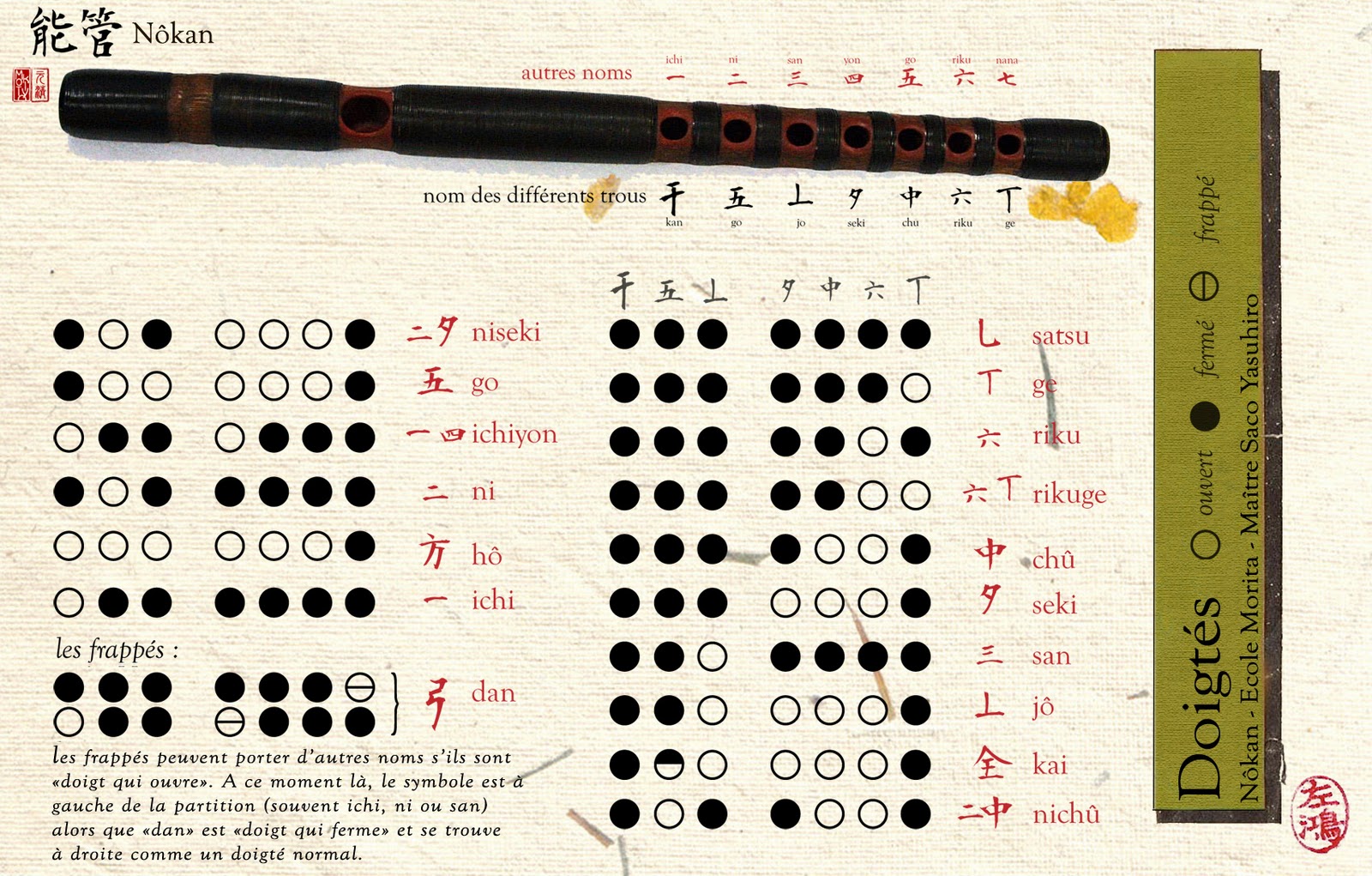
It is rather strange that, despite two years of regular lessons (I go to Japan once a week, for two years now, for a one-hour weekly lesson!) and untimely research, I have almost never talked about the Nôkan here.
Yet when you try to look into the subject, it is almost impossible to find any reference at all, and when they exist they are often approximate and/or incomplete. There are, I am sure, mines of information on the net for those who read and write Japanese. Unfortunately, I am not one of them.
Of course, this is an instrument practised in the intimacy of temples or traditional rooms of a few tatami with paper doors. Here, we enter the codes of ancient Japan. The master (sensei, the one who masters and transmits his art) receives you in a kimono. Sitting in seiza, behind a little wooden cube on which he beats the measure while singing the lines of the percussion, he faces the students, who go through one after the other in respectful silence. Those who wait for their turn drink tea around a low table and murmur their shoka between their teeth, while supporting the student who, facing the master, goes through the ordeal of rhythms broken by shouts. Like a fight lost in advance. With a knot in the throat, one awaits one’s turn. And once one has been through it, one stays another half hour or an hour to recover from this face to face.
Here, there is no schedule. The class runs from 6 to 9 pm and you just come. You take your place beside the other students and wait patiently for your turn. Often, afterwards, as a reward, we meet in a little Japanese restaurant. The sensei has taken off his master’s garb, set down his mask and the codes of this ancestral art, to put on the costume of the simple 21st-century man he is in town. A man who drinks, laughs and chats with his students, who have become, once past the pediment of the temple, something like his friends.
The Nô flute, the Nôkan, is the instrument by which the spirits are called to descend onto the butai (the stage of the nô theatre) to take possession of the dancer-actors. One will then understand the full importance of the ceremonial. We are no longer simply music students, we are learning to rub shoulders with the gods, with their rules and their moods. It is forbidden, for example, to wear a necklace or a watch, any jewellery that could hinder the coming of the music. The flute is not held like a « vulgar » instrument. The way of taking it in hand is governed by multiple codes that are repeated tirelessly.
In this art, there are no books, no scores. The master, when he judges that we have mastered a piece well enough, writes out the next shoka for us on Japanese music paper, divided into eight beats from top to bottom, on eight lines from right to left. The shoka is the song. The syllables in katakana do not represent the notes, only the song. A ヒャ (Hya) may be, in one phrase or piece, a seki (the name of one of the fingerings, see the chart) and, in another phrase or piece, a Jô (another fingering).
The master then, beside his shoka written in black ink, inscribes in red ink the secret keys that will allow the Nôkan to take back its rights and intone the secret music hidden behind these katakana.
But beware, the shoka still gives the rhythmic information! And besides, by singing them in our heads while we play, the nôkan sounds in a different way! That, at least, is what we are told!
For all these reasons, one will readily understand that its diffusion remains minimal. At the same time, it is also thanks to this that the Nôkan, like the other instruments of the nô theatre, keeps this inimitable character. Here, the West has not entered! It is behind the door… it dreams, it fantasises. Like about the samurai and the shogun whom, for an instant, thanks to this music, we find again. Out of space and time. Elsewhere.
Editor’s note: I AM SPEAKING HERE OF A SINGULAR EXPERIENCE TIED TO ONE MASTER AND ONE SCHOOL: MORITA SCHOOL. The other two schools, the best known ISSO and the third, FUJITA, may not transmit in the same way. What I do know, for example, is that the ISSO school has many different fingerings.